What Is Himalayan Pink Salt?
Himalayan pink salt is a naturally occurring rock salt mined from ancient geological deposits in the Salt Range mountains of Punjab, Pakistan. Formed approximately 250 to 600 million years ago when primordial seas evaporated, these salt beds were gradually sealed under layers of rock and lava, preserving their mineral-rich composition in pristine condition far below the earth's surface.
Unlike industrially refined table salt, Himalayan pink salt is minimally processed. It is hand-mined, carefully washed, and sun-dried or kiln-dried without the addition of bleaching agents, anti-caking chemicals, or artificial iodisation. This gentle approach preserves the 84 trace minerals — including iron, calcium, magnesium, potassium, and zinc — that give the salt its distinctive rose-pink colour and subtle, complex flavour profile.
Pakistan is the world's primary source of authentic Himalayan pink salt. The Khewra Salt Mine, located in the Jhelum District of Punjab, is the world's second-largest salt mine and produces the majority of the global supply. Additional mines in Warcha, Kalabagh, and other locations across the Salt Range contribute to Pakistan's annual production of over 400,000 tonnes.
Quick Fact
The Khewra Salt Mine was discovered by the troops of Alexander the Great in 326 BC when their horses began licking the salt-rich stones. Today it spans 110 square kilometres across 19 levels, with only the top 8 levels commercially mined — ensuring centuries of supply remain below.
Himalayan Pink Salt vs Regular Table Salt
Both Himalayan pink salt and standard table salt are predominantly sodium chloride (NaCl), typically 95-98% and 99.5%+ respectively. However, the differences in processing, mineral content, and additives are substantial:
| Parameter | Himalayan Pink Salt | Regular Table Salt |
|---|---|---|
| Processing | Hand-mined, washed, sun-dried | Heavily refined, bleached, chemically treated |
| Mineral content | 84 trace minerals (iron, calcium, magnesium, potassium, zinc) | Pure NaCl, minerals stripped during refining |
| Additives | None — 100% natural | Anti-caking agents (sodium aluminosilicate, calcium silicate), iodine |
| Colour | Pink to deep rose (from iron oxide) | White (from bleaching) |
| Flavour | Subtle, complex, slightly sweet mineral notes | Sharp, purely salty |
| Sodium per gram | ~368mg (lower due to mineral content) | ~388mg |
| Source | Ancient geological deposits, Pakistan | Sea water evaporation or underground mining (various countries) |
The lower sodium-per-gram ratio in Himalayan pink salt comes from the space occupied by trace minerals within the crystal lattice. While the difference is modest, it means that gram-for-gram you consume slightly less sodium while gaining trace mineral intake — a combination that appeals to health-conscious consumers worldwide.
Health Benefits of Himalayan Pink Salt
Himalayan pink salt has been used for centuries in traditional wellness practices across South Asia and the Middle East. While it should not be considered a medicine, its natural mineral composition offers several advantages over refined salt:
Electrolyte Balance and Hydration
The trace minerals in Himalayan pink salt — particularly sodium, potassium, magnesium, and calcium — are essential electrolytes that help regulate fluid balance, nerve signalling, and muscle function. Athletes and health-conscious consumers often dissolve a pinch of Himalayan salt in water (a preparation known as sole water) as a natural electrolyte replenisher after exercise or during hot weather.
Respiratory Health (Halotherapy)
Salt therapy, or halotherapy, involves inhaling micro-particles of salt in a controlled environment. Salt rooms and salt caves — many constructed using Himalayan pink salt bricks — have become increasingly popular in wellness centres across Europe, the GCC, and North America. The antibacterial and anti-inflammatory properties of salt aerosol may help ease symptoms of asthma, bronchitis, allergies, and sinusitis, though medical evidence remains an active area of research.
Skin Health and Bath Therapy
Dissolving Himalayan pink salt in warm bath water creates a mineral-rich soak that may help soften skin, reduce inflammation, ease muscle soreness, and support relaxation. The magnesium content is particularly valued for its role in muscle recovery. Himalayan salt scrubs and bath salts are a fast-growing segment in the global natural cosmetics market.
Mineral Supplementation
While the amounts of trace minerals per serving of salt are small, the cumulative effect of daily consumption provides supplementary intake of iron, zinc, chromium, and manganese — micronutrients that many modern diets are deficient in. Replacing refined table salt with Himalayan pink salt is a simple dietary swap that adds nutritional value without changing habits.
Himalayan pink salt is not a medicine — it is a food ingredient with a naturally superior mineral profile. The health advantage lies in what it does not contain (bleach, anti-caking chemicals, microplastics) as much as in what it does contain (84 trace minerals).
Types and Product Forms
Himalayan pink salt is available in a remarkably wide range of product forms, each targeting different end uses and market segments. As a direct exporter from Pakistan, Kohenoor International supplies all of the following:
Fine Grain Salt (0.1-0.5mm)
The most common culinary form. Fine-grain Himalayan pink salt flows freely from standard salt shakers and dissolves quickly in cooking. It is a direct replacement for table salt in everyday use — seasoning, baking, and food preparation. The fine grain format is the largest volume segment in retail markets across Europe, the GCC, and North America.
Coarse Grain Salt (2-5mm)
Preferred by chefs and gourmet food producers for use in salt grinders, as a finishing salt, and in curing and brining. Coarse Himalayan salt delivers a satisfying crunch and visual appeal when sprinkled over dishes. It dissolves more slowly, making it ideal for slow-cooking methods, meat curing, and pickling.
Rock Salt Chunks (various sizes)
Large, uncut pieces of Himalayan salt — ranging from small display crystals to 25+ kg boulders. Rock chunks are used for decorative purposes, wellness displays, salt room construction, and as raw material for further processing into lamps, tiles, and custom shapes. The natural crystal formations showcase the full spectrum of pink, rose, and amber hues.
Himalayan Salt Lamps
Carved or natural-form salt crystals hollowed to hold a light source. Pink salt lamps emit a warm amber glow and are marketed for their decorative appeal and purported air-purifying properties. The global salt lamp market has grown significantly, driven by demand from wellness-oriented consumers in the US, Europe, Japan, and Australia.
Cooking Plates and Tiles
Thick slabs of solid Himalayan salt, precision-cut and polished, used as cooking and serving surfaces. When heated on a grill or stovetop, salt plates impart a delicate salinity and trace mineral flavour to food. They can also be chilled and used to serve sushi, carpaccio, fruits, and cold dishes. The same plates work as elegant serving platters for premium dining presentations.
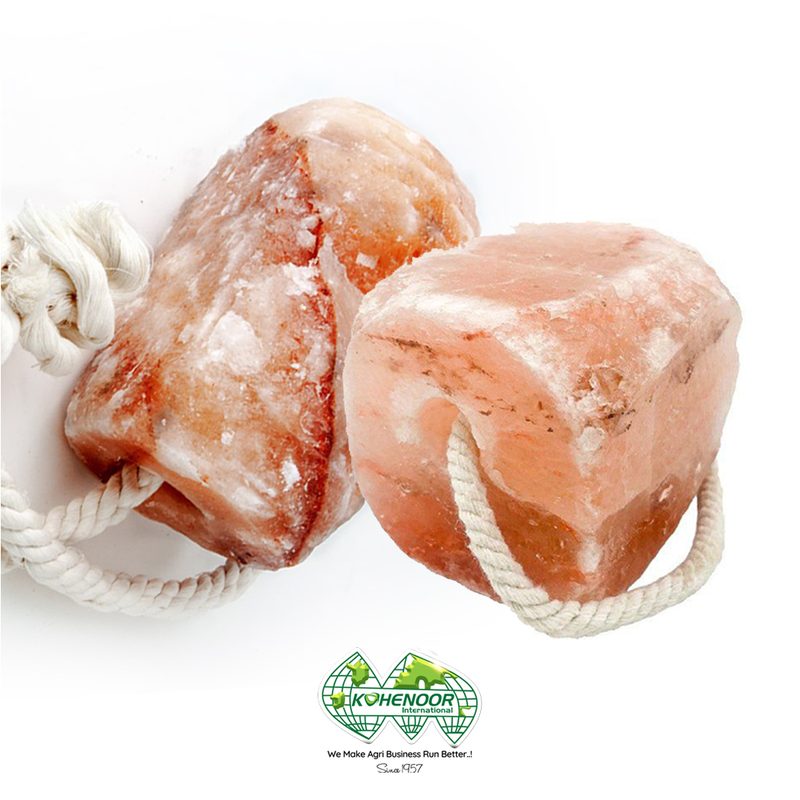
Salt Lick Blocks (Animal Feed)
Solid blocks of Himalayan salt — typically 2-5 kg — designed for livestock, horses, and wildlife. Salt lick blocks provide essential minerals (sodium, calcium, iron, zinc, magnesium) that support animal health, hydration, and feed efficiency. The dairy and livestock industry across the Middle East, Africa, and Europe is a major buyer of this product form. Pakistan is the world's largest exporter of natural salt lick blocks.
Custom and Specialty Forms
Himalayan pink salt can be processed into shot glasses, mortar and pestle sets, inhalers (for halotherapy), bath bomb ingredients, soap bars, and candle holders. The versatility of the material — combined with its visual appeal and mineral story — has spawned an entire category of salt-based lifestyle and wellness products.
Source Premium Himalayan Pink Salt from Pakistan
Kohenoor International exports all forms of Himalayan pink salt — fine grain, coarse, rock chunks, lamps, cooking plates, and salt lick blocks. ISO 9001 certified, HACCP compliant, with lab reports on every shipment. MOQ starts at 1 MT.
Request a Quote →Nutritional Profile
The nutritional value of Himalayan pink salt per 100 grams:
| Nutrient | Amount per 100g | Notes |
|---|---|---|
| Sodium | 36,800mg | ~5% less than refined table salt |
| Chloride | 59,000mg | Primary anion |
| Calcium | 1.5-4.0mg | Bone and muscle health |
| Magnesium | 0.1-1.0mg | Muscle recovery, nerve function |
| Potassium | 2.5-3.5mg | Electrolyte balance |
| Iron | 0.3-0.5mg | Gives the pink colour |
| Zinc | 0.02-0.04mg | Immune support |
| Total trace minerals | 84 identified | Including copper, manganese, chromium, selenium |
| Calories | 0 | Zero calorie ingredient |
Culinary Uses of Himalayan Pink Salt
Himalayan pink salt has become a staple in professional and home kitchens worldwide, valued for both its flavour nuance and visual appeal:
Everyday Cooking and Seasoning
Fine-grain Himalayan salt is a 1:1 replacement for table salt in all cooking applications. Its slightly milder, more rounded flavour — with faint mineral sweetness — enhances ingredients without the harsh sharpness of refined salt. Use it for seasoning meats, vegetables, soups, sauces, and baked goods exactly as you would regular salt.
Finishing Salt
Coarse or flaked Himalayan salt sprinkled over a completed dish adds visual drama (the pink crystals are striking against dark chocolate, grilled steak, or salads) and a satisfying crunch with each bite. This is the highest-value culinary application, commanding premium pricing in gourmet retail.
Curing, Brining, and Pickling
The natural mineral content of Himalayan salt makes it excellent for dry-curing meats (prosciutto, bacon, gravlax), wet brining poultry and pork, and pickling vegetables. The trace minerals contribute subtle flavour complexity to preserved foods that refined salt cannot match.
Salt Block Cooking
Himalayan salt plates heated to 200-260°C (400-500°F) serve as a searing surface for steaks, seafood, and vegetables. The food absorbs a gentle salinity directly from the block, creating a unique flavour experience. Chilled salt blocks work equally well for serving and presenting cold dishes like sashimi, carpaccio, cheese, and fruit.
Industrial and Commercial Applications
Beyond food and wellness, Himalayan pink salt serves several significant industrial markets:
Livestock and Dairy Feed
Salt lick blocks are essential for livestock health in dairy farming, equestrian facilities, and wildlife reserves. Animals naturally seek salt to maintain electrolyte balance, hydration, and mineral intake. Pakistani salt lick blocks are exported in massive volumes to the Middle East, Africa, Europe, Australia, and Southeast Asia for cattle, horses, sheep, goats, and deer.
Spa, Wellness, and Halotherapy
Salt rooms built from Himalayan salt bricks and panels are a growing segment in the wellness industry. Salt cave construction, float tank salt supply, and halotherapy equipment all use Himalayan pink salt. The spa and wellness market is particularly strong in Germany, Poland, the UK, the UAE, and the United States.
Cosmetics and Personal Care
Himalayan salt is a key ingredient in bath salts, body scrubs, soap bars, facial mists, and mineral-infused skincare. The combination of natural mineral content, gentle exfoliation, and clean-label appeal makes it attractive to the rapidly growing natural cosmetics sector.
Quality Parameters for Buyers
When sourcing Himalayan pink salt in bulk, professional buyers should evaluate the following quality parameters:
| Parameter | Food Grade | Industrial Grade |
|---|---|---|
| NaCl content | 97-98.5% | 95-97% |
| Moisture | < 0.5% | < 1.0% |
| Insoluble matter | < 0.5% | < 1.5% |
| Iron (Fe) | 20-50 ppm | Variable |
| Lead (Pb) | < 2 ppm | < 5 ppm |
| Arsenic (As) | < 0.5 ppm | < 1 ppm |
| Mercury (Hg) | < 0.1 ppm | < 0.5 ppm |
| Mesh size (fine) | 20-80 mesh | As specified |
| Colour consistency | Uniform pink to rose | Mixed acceptable |
Buyer's Tip
Always request a Certificate of Analysis (COA) with heavy metal testing, NaCl content, moisture, and microbiological results for every shipment. Reputable exporters like Kohenoor International provide this as standard practice. For food-grade applications, ensure the supplier holds both ISO 9001 and HACCP certification.
Why Source Himalayan Pink Salt from Pakistan?
Pakistan is not just the primary source — it is the only authentic source of Himalayan pink salt. Here is why sourcing directly from Pakistani exporters makes commercial sense:
- Authenticity guarantee: Only salt mined from Pakistan's Salt Range qualifies as genuine Himalayan pink salt. Some suppliers rebrand sea salt or rock salt from other origins — buying directly from Pakistan eliminates this risk.
- Competitive pricing: Cutting out intermediaries by buying FOB Karachi directly from the source country gives the best per-tonne pricing in the global market.
- Full product range: Pakistani exporters can supply all forms — fine, coarse, chunks, lamps, tiles, lick blocks, and custom shapes — from a single source, simplifying your supply chain.
- Scale: Pakistan's annual production exceeds 400,000 tonnes, ensuring reliable supply for both small specialty orders and large industrial contracts.
- Shipping advantage: Karachi port offers competitive freight rates to the GCC, East Africa, South and Southeast Asia, Europe, and the Americas via established shipping lines.
How to Store Himalayan Pink Salt
Himalayan pink salt is exceptionally shelf-stable due to its low moisture content and mineral composition. Whole rock chunks and coarse grain can be stored indefinitely in a dry environment. Fine-grain salt should be kept in airtight containers to prevent clumping from humidity absorption — though unlike table salt, Himalayan salt contains no anti-caking agents, so mild clumping in humid conditions is natural and does not indicate quality degradation. Simply break up any clumps and use normally.
For commercial storage, maintain warehouse conditions below 65% relative humidity and store pallets on elevated racks away from direct moisture exposure. Properly packaged, containerised Himalayan salt has a virtually unlimited shelf life.
Frequently Asked Questions
Is Himalayan pink salt better than sea salt?
Both are less processed than table salt, but they differ in origin and composition. Himalayan salt comes from ancient, sealed deposits free from modern ocean pollutants, while sea salt is evaporated from current ocean water and may contain microplastics and environmental contaminants. Himalayan salt also has a more consistent mineral profile and is available in a wider range of product forms.
Can Himalayan pink salt expire?
No. Salt is a natural mineral that does not spoil, decompose, or lose potency over time. Properly stored Himalayan pink salt has an indefinite shelf life. Packaging may carry a "best before" date for regulatory compliance, but the salt itself does not expire.
Is the colour natural or added?
The pink colour is entirely natural — it comes from trace iron oxide and other minerals embedded in the crystal structure over millions of years. No dyes, colouring agents, or processing chemicals are added at any stage. Colour variation between batches (from light pink to deep rose) is normal and reflects natural mineral variation between different mine veins.
How much Himalayan salt should I use daily?
Himalayan pink salt should be used in the same quantities as any other dietary salt — the World Health Organisation recommends less than 5 grams of total salt per day for adults. While Himalayan salt contains trace minerals, it is still predominantly sodium chloride and should be consumed in moderation as part of a balanced diet.